
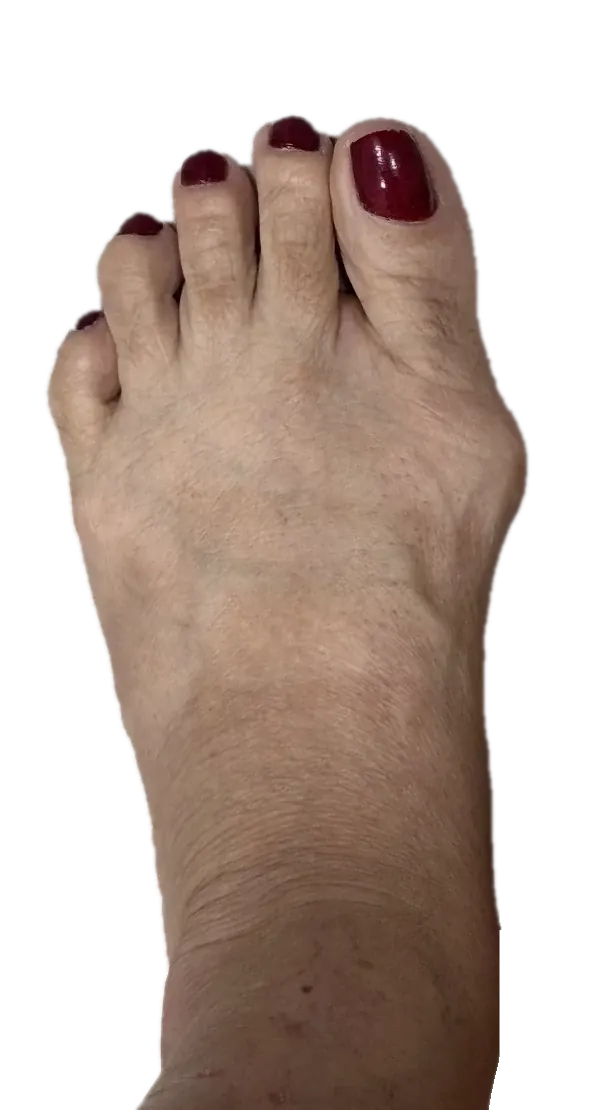
What it is
From the outside, a bunion is the bump on the side of the big toe, with the big toe leaning toward the other toes.
How it often shows up: “A bump on the side of the big toe that hurts in shoes”.
Inside
Inside, there is no new bone. These are the same bones, out of place: the long bone of the big toe, the first metatarsal, has drifted away from the second metatarsal, and its head has slipped off the sesamoids.
The first metatarsal angles one way and the big toe bends the other way. The angle between the two is what is measured on the X-ray. The “bump” is the head of the bone.
Treatment
Most foot and ankle pain improves with the right shoes, insoles and physical therapy. Surgery is for when that does not work and the pain holds your life back.
When wide shoes, insoles and physical therapy do not control the pain, surgery corrects the misalignment of the bone. In the minimally invasive technique, a fine burr cuts the bone through tiny incisions in the skin, and the metatarsal head is shifted back into place and fixed with screws.
The technique depends on the degree of deformity. Every surgery has risks, such as infection, stiffness and recurrence of the deformity.
Afterwards
The bone heals in its new position over the following weeks. Weight-bearing, footwear and the return to activities follow the plan set for your case.
Results and recovery vary from person to person.
What I look at in the visit
- Big toe (hallux)2 phalanges
- It is the toe that pushes hardest against the ground at the end of each step.
- In the visit I look at: where it points, how far it bends and whether it hurts to move.
- 1st metatarsalthe bunion bone
- Long bone that supports the big toe. When it drifts outward, its head forms the bunion.
- In the visit I look at: its angle on a standing X-ray.
- Sesamoids2 small bones
- They sit under the head of the 1st metatarsal and work as a pulley for the big toe tendon.
- In the visit I look at: whether they are still under the bone or have moved out of place.
- Lesser toes2nd to 5th
- They suffer when the big toe pushes on them: they can curl into claw toes and form calluses.
- In the visit I look at: calluses, weight-bearing and mobility of each toe.
- Metatarsals2nd to 5th
- They share the load at the front of the foot. Overload here causes pain in the “ball” of the foot.
- In the visit I look at: tender spots and calluses on the sole.